Things that jump out
Firstly, barriers to progress in the commercialisation of bee keeping are well known, broad, and seemingly institutionalised.
The delegates at the symposium were able to recite the issues with commonality. These are struggles with financing businesses and the challenges of obtaining enough honey of the right quality and with supply reliability. This reflects the under-development of all aspects of the value chain.
Secondly, one common topic was the cultural view of bees in East Africa which – as it was explained to me – is often founded on suspicion and inter-generational negativity about the presence of bees near homes and what they mean as a curse that someone places on another. This is partly practical as the stings of 12 African honey bees has the same venom as some cobra bites.
The dominance of NGOs and charities. This is a complex topic and not one that I know enough about at present. However, I’m firmly in the commercial camp so naturally distance myself from influences that build-in a perpetual reliance on precarious inputs. On the positive side of the NGO coin, there is a lot of science going on to understand biological and ecological issues. This is funded by external money including the EU. See the banner below.
Where are the commercial sponsors?
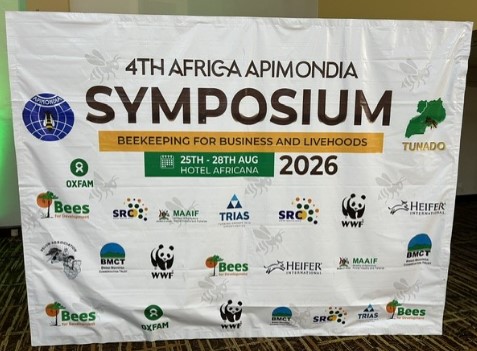
This is a well-attended and expanding event with people coming from all over Africa and the rest of the World – testament to the attraction of the sector and its potential.
People here enjoy themselves
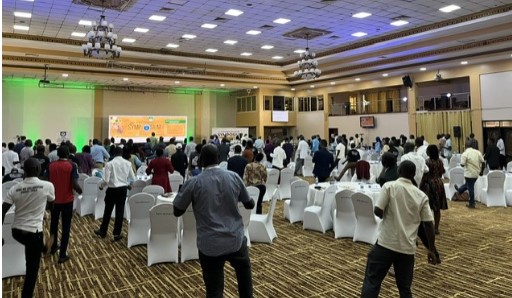
An energiser session is shown below with the whole audience doing boxing training.
It was well worth coming to Uganda. I’ve made some great contacts, heard a lot of interesting opinions, changed and / or adapted my view of my research topic, and I think I’ve moved the topic forward a bit for those who took part in the intervention.
The door is opened for another leg in this intervention or another one entirely.